
Blog
Sink or Swim: What Climate Adaptation Demands of Us
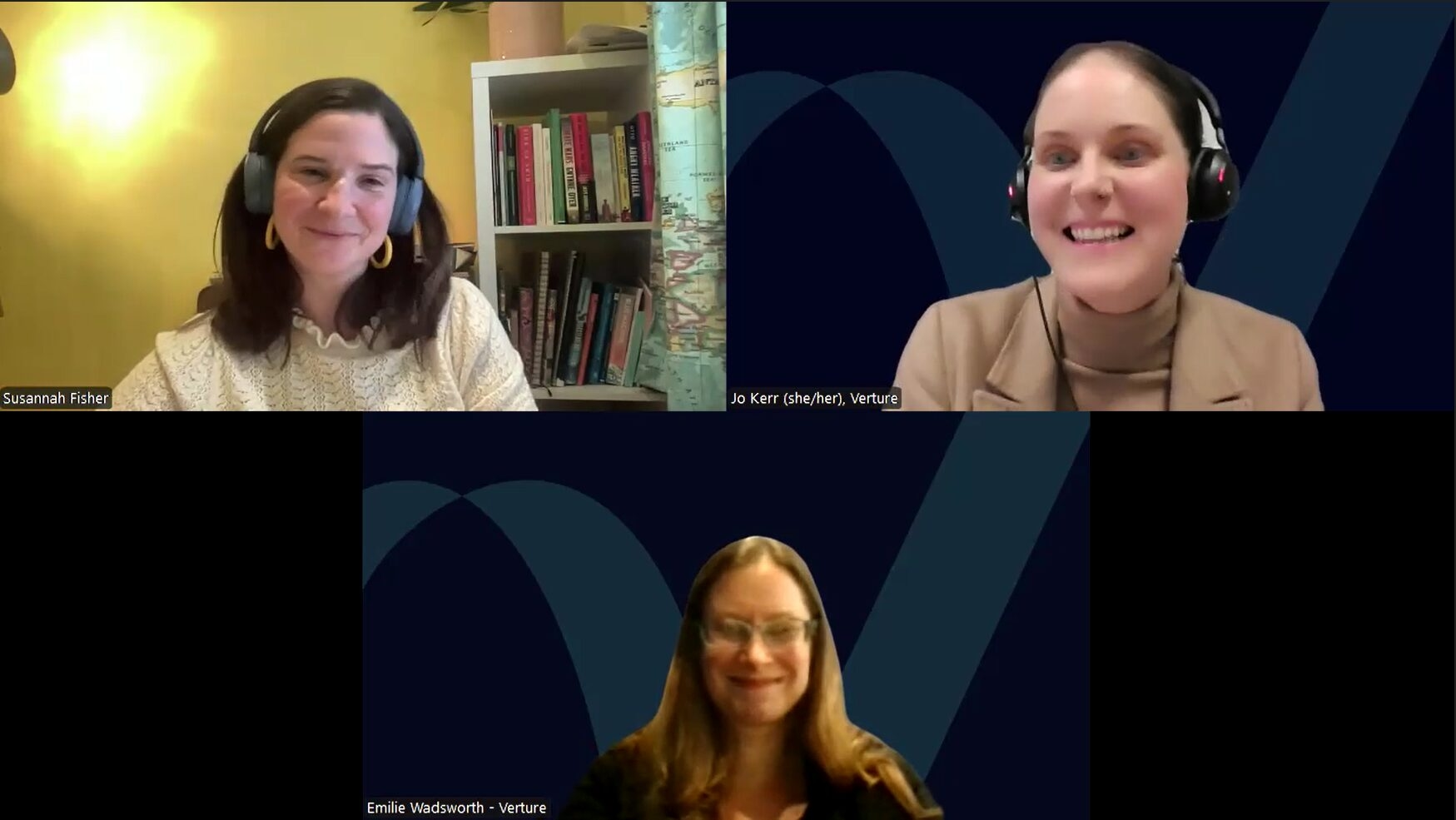
Last week, Verture hosted a Climate Ready Leaders discussion around Sink or Swim: How the World Needs to Adapt to a Changing Climate by Dr Susannah Fisher. The conversation brought together people working across climate, funding, policy, research and community action.
The discussion was led by Jo Kerr, CEO of Verture, in conversation with Dr Fisher and Emilie Wadsworth, Verture’s Leadership Programme Manager
Beyond a single solution
Rather than focusing on one solution or framework, the discussion highlighted that there is no single “mega theory” of adaptation. Climate adaptation plays out across complex, interconnected systems. Decisions in one area often create unexpected consequences in another.
A key takeaway was the gap between imagination and implementation. While climate risks are well evidenced, adaptation action often stalls when it encounters hard political choices. Emilie reflected on how climate considerations can be overridden by short-term pressures, for example through continued development on flood plains, or decisions that shift risk onto communities least able to absorb it.
There was recognition that communities are already making meaningful local changes. However, without enabling structures and wider systems of support, communities are too often left carrying the burden of adaptation alone.
Hard choices and political reality
Sink or Swim identifies four key systems where particularly hard choices lie ahead: human mobility, food systems, the natural world, and conflict and relationships between people.
Susannah discussed why adaptation frequently receives less attention and investment than emissions reduction, despite climate impacts already being experienced.
There was also discussion about how risk is managed and shared. While governments often talk about risk-based decision-making, adaptation is still frequently treated as optional rather than essential. Participants reflected on who carries risk, who pays for adaptation, and how responsibility is shared.
Food systems, trade-offs and unintended consequences
Food systems emerged as a vivid example of adaptation complexity. A key takeaway from the discussion was how vulnerable current food systems are due to the lack of diversity. One participant highlighted that Sink or Swim notes there are over 7,000 edible plant species globally, yet only around 400 are considered food crops, with a far smaller number dominating industrial agriculture.
The discussion explored the tensions between producing “enough” food and the environmental and social costs of intensive farming. A central takeaway was the trade-off between productivity and resilience. While many farmers are already adapting – responding to changing seasons and weather patterns – support at a local level is often fragmented.
Climate migration was discussed not as a distant future issue, but as a present reality. The discussion explored how adaptation planning can better account for human mobility and how decisions about land, food and housing intersect with displacement, inequality and narratives around “climate refugees”.
Adaptation, justice and ending with hope
Bringing a Scottish perspective , Emilie reflected on what good adaptation looks like at community level: preventative, place-based, long-term, and co-designed with the people who live there.
A key thread running throughout the session was the relationship between adaptation and justice. Jo and Susannah reflected on how climate resilience and social resilience are deeply intertwined, and how adaptation that ignores poverty, access to services or power imbalances risks doing more harm than good.
Adaptation is not just a technical challenge – it is a political and ethical one, involving choices about where people live, how resources are shared, how risks are managed, and whose voices are heard.
Susannah ended on a hopeful note, reflecting that change does not come from a single silver bullet, but from many people working on different levers within a complex system. Taking action is one of the strongest antidotes to fear and anxiety about the future. Focusing on what we can do – today – is how systems begin to shift.
Watch the full discussion below:
